VirtualProtect (kernel32.dll)
TLDR: VirtualProtect changes the protection on a region of committed pages in the virtual address space of the calling process.
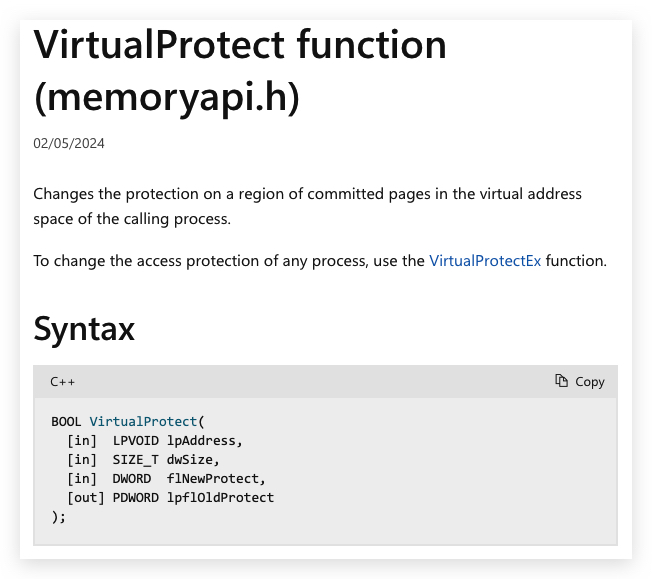
https://learn.microsoft.com/en-us/windows/win32/api/memoryapi/nf-memoryapi-virtualprotect
Executive Summary
VirtualProtect is a Windows API function that changes the protection attributes of a region of committed pages in the virtual address space of the calling process. This function can be used to change the access rights of a memory region, allowing for more granular control over memory protection.
Executive Summary
VirtualProtect modifies the protection attributes of a memory region within a process, akin to switching a memory segment from read-only to executable. It’s a pivotal Windows API frequently leveraged in post-exploitation scenarios, particularly when attackers aim to execute freshly written code in memory. While its use is common in legitimate software, making it inherently noisy, its appearance in injection or evasion workflows marks it as a critical indicator of compromise. From enabling shellcode execution to bypassing security mechanisms or staging stealthy operations, VirtualProtect is a linchpin in many malicious activities.
Why It Matters
VirtualProtect is significant because it often signals the moment malicious activity becomes operational. It frequently appears just before shellcode execution, after unhooking security tools, or during evasion tactics. Though noisy in isolation due to its use in legitimate applications, when paired with memory allocation or write operations, it becomes a strong indicator of malicious intent. Detecting it in context can reveal injection or bypass techniques that might otherwise go unnoticed.
How Attackers Abuse It
VirtualProtect alters the protection settings on a region of memory pages within a process. Pages are fixed-size memory blocks managed by the operating system, forming a process’s virtual address space. Attackers exploit this API to make non-executable memory regions executable, enabling malicious code execution, evading security hooks, or thwarting analysis.
- Injection: After allocating memory and writing shellcode, attackers use VirtualProtect to mark the region as executable, enabling code execution.
- Unhooking: Employed to make hooked APIs writable, restore original bytes, and reinstate execute permissions, circumventing EDR monitoring.
- Anti-debugging: Modifies memory associated with breakpoints or debugger stubs (e.g., DbgBreakPoint, DbgUiRemoteBreakin) to disrupt debugging efforts.
- Evasion: Changes memory protections to bypass security controls or sandbox restrictions, facilitating stealthy operations.
NOTE:
VirtualProtectcan only modify memory protections incurrent process. It is a wrapper that ultimately calls NtProtectVirtualMemory (which can modify protections across processes). It simplifies the interface for user-mode applications by handling the current process context automatically.